
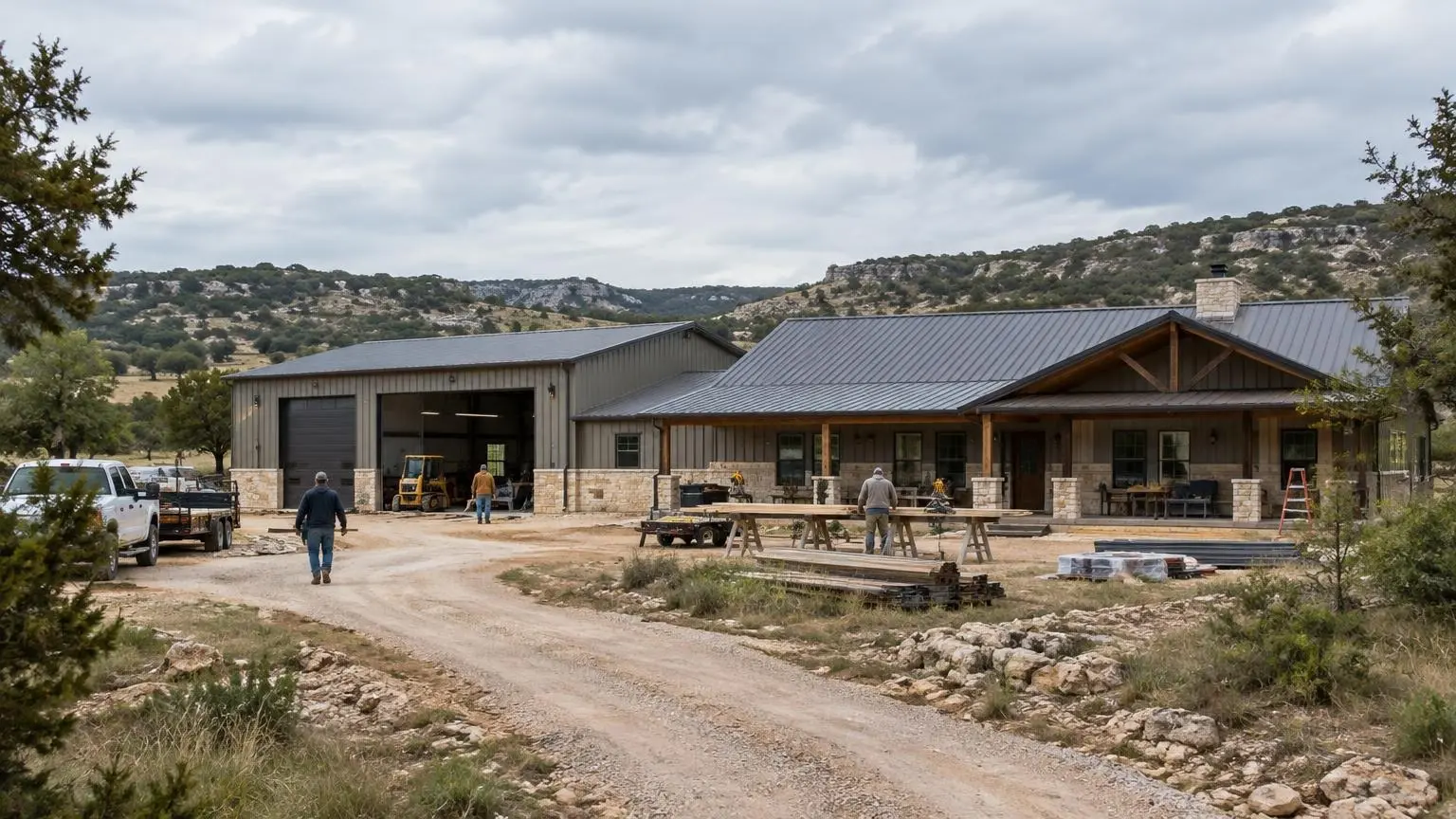
Texas barndominiums, built for your county
Barndominium Builders in Texas
Custom barndos, shop houses and metal building homes on Texas land, from the Hill Country to the Panhandle.
- Free on-site land visits
- Written, line-item estimates
- County permit and septic research included
A Barndominium Has to Fit the Land It Sits On
Barndominium builders in Texas work in a state where a 40x60 steel building can sit on limestone ledge in Kendall County, on shrink-swell black clay outside Temple, in pine woods east of Tyler or on the caliche plains near Lubbock. We build barndominiums, metal building homes and shop houses across Texas outside the Houston and Dallas-Fort Worth metros, and every build starts with the ground, the county and how you plan to live and work on the property.
What we build
- Custom barndominiums drawn around your acreage, views and shop needs
- Barndominium kits erected on a slab we pour, or a kit you already bought
- Floor plans from compact 30x40 layouts to large 50-plus-foot-wide homes with shops
- Metal building homes with a steel frame and a conventional-looking finish
- Shop houses that put a working shop and living quarters under one roof
- Turnkey barndominiums from site prep through final cleaning
Rural Texas permitting is different
Inside city limits, a barndo goes through the city building department like any house. Out in the county, rules vary. Under Texas Local Government Code Chapter 233, Subchapter F, a county can adopt an order applying residential building standards to new single-family homes in its unincorporated area. Where that applies, the home has to meet the International Residential Code version published as of May 1, 2008, or the version used in the county seat, and the builder needs at least three inspections: the foundation before concrete is placed, framing and mechanical systems before the walls are covered, and a final. The same subchapter does not require county approval before construction begins and does not give the county power to zone. Out in the county, then, the practical limits usually come from deed restrictions, the septic program, flood rules and the lender, not a zoning map. We check each of those before you commit to a design.
Septic comes before the slab
Most rural Texas lots need an on-site sewage facility. Septic systems are regulated by TCEQ, and in most counties a local authorized agent runs the permit program. In Comal County, for example, the process starts with a site and soil evaluation, then a system choice and plan, then a review; building cannot begin until the county issues its authorization to construct, and the system gets three inspections during installation. Complex systems, and systems over the Edwards Aquifer recharge zone, have to be designed by a registered engineer or sanitarian. The soil report often decides where the house can sit, so we look at it early.
Metal buildings sweat if you let them
Warm, humid air meeting cold steel turns into water on the underside of the roof. Across East Texas, the coast and Central Texas summers, that is a design problem, not a rare event. We plan insulation, vapor control and HVAC sizing for the whole envelope before ordering the building, and we keep living areas and shop areas on separate thermal plans when they need to be.
Financing and appraisal, in plain terms
Barndominiums can be harder to appraise than conventional houses, which can limit conventional mortgages, according to HomeGuide. Texas Farm Credit describes one-time construction loans, where the lender often manages the draw process, and recommends showing up with floor plans, a supply list, contractor bids, a timeline and cost estimates. Our written, line-item estimate and phase schedule are built to be handed to a lender.
Where We Build Barndominiums in Texas
We build across Texas outside the Houston and Dallas-Fort Worth metros. The state's regions differ enough that the same floor plan gets a different foundation, wall package and schedule depending on where it lands.
Hill Country and the Edwards Plateau
West of Austin and San Antonio, the Hill Country is the southeast edge of the Edwards Plateau: karst limestone and granite hills from about 980 to 2,460 feet, a thin layer of topsoil with exposed rock and boulders, and Ashe juniper and live oak on the slopes. It is also called Flash Flood Alley, with significant floods in 1978, 1987, 1998, 2002 and 2025. Here we plan for rock excavation, pad placement above drainage paths, and septic designs that fit shallow soil. Over the Edwards Aquifer recharge zone, septic plans need an engineer or sanitarian.
The I-35 Blackland Prairie corridor
From north of Dallas to San Antonio, Houston Black clay, the Texas state soil, covers about 1.5 million acres of the Blackland Prairie. It is a classic shrink-swell soil: it cracks when dry and swells when wet, and that movement often limits building site development. Around Waco, Temple, Killeen, Georgetown and the east side of Austin, slab design and drainage around the building matter as much as the steel above them.
East Texas Piney Woods
Around Tyler, Longview, Lufkin and Nacogdoches, the Piney Woods typically get 40 to 52 inches of rain a year, with some areas over 60. Upland soils are mostly loamy and well drained, while floodplains and low terraces are clayey and poorly drained. Lot clearing, stump removal, drainage and condensation control are the big items. Texas Farm Credit notes barndominiums are popular all over East Texas.
Coastal Bend and the Gulf side
Corpus Christi is the largest city of the Coastal Bend, which traditionally includes Aransas, Bee, Brooks, Jim Wells, Kenedy, Kleberg, Nueces, Refugio and San Patricio counties. Fourteen coastal counties (plus part of Harris County east of Highway 146) are in the Texas Department of Insurance designated catastrophe area, where most new homes need a WPI-8 windstorm inspection during construction to qualify for TWIA wind coverage. We schedule those inspections into the build.
West Texas, the South Plains and the Panhandle
The Llano Estacado rises from about 3,000 feet in the southeast to over 5,000 in the northwest, with caliche capping the Ogallala Formation and under 23 inches of rain a year. Lubbock is its largest city; Midland, Odessa and Amarillo are the other big centers. Amarillo, at about 3,700 feet, averages 17.9 inches of snow, gets wind gusts of 50 mph or more each year, and has an average first freeze around October 20. Up here we think about wind, snow drifting at overhead doors, hail and well water from the Ogallala.
Brazos Valley, North Texas and in between
We also build around College Station and Brenham, Wichita Falls and Sherman, Abilene and San Angelo. Each town page covers what is different locally.
- Barndominium Builders in Austin, TX
- Barndominium Builders in San Antonio, TX
- Barndominium Builders in Waco, TX
- Barndominium Builders in Temple, TX
- Barndominium Builders in Killeen, TX
- Barndominium Builders in Georgetown, TX
- Barndominium Builders in New Braunfels, TX
- Barndominium Builders in San Marcos, TX
- Barndominium Builders in Seguin, TX
- Barndominium Builders in Boerne, TX
- Barndominium Builders in Fredericksburg, TX
- Barndominium Builders in Kerrville, TX
- Barndominium Builders in Dripping Springs, TX
- Barndominium Builders in Bastrop, TX
- Barndominium Builders in College Station, TX
- Barndominium Builders in Brenham, TX
- Barndominium Builders in Tyler, TX
- Barndominium Builders in Longview, TX
- Barndominium Builders in Lufkin, TX
- Barndominium Builders in Nacogdoches, TX
- Barndominium Builders in Beaumont, TX
- Barndominium Builders in Corpus Christi, TX
- Barndominium Builders in Victoria, TX
- Barndominium Builders in Lubbock, TX
- Barndominium Builders in Amarillo, TX
- Barndominium Builders in Abilene, TX
- Barndominium Builders in San Angelo, TX
- Barndominium Builders in Midland, TX
- Barndominium Builders in Wichita Falls, TX
- Barndominium Builders in Sherman, TX
Common Questions
How much does it cost to build a barndominium in Texas?
Total cost depends on size, finish level and how much site work the land needs: clearing, pad, septic, well and power. Each service page has a table of published cost ranges from HomeGuide, and the custom and turnkey pages show Texas per-square-foot figures. Land is not included in those ranges. Our written estimate after a land visit is the price.
Do I need a building permit for a barndominium in a Texas county?
Inside a city, yes. In unincorporated areas it depends on the county. Counties that opt into Local Government Code Chapter 233, Subchapter F require new homes to meet the IRC and get three inspections, but the law does not require county approval before construction starts. Separate septic, floodplain and driveway permits often apply either way.
Can I build a barndominium on land without city water or sewer?
Yes, that is how most rural Texas barndos are built. You will need a permitted septic system and either a well or a water co-op connection. The septic soil evaluation should happen before the house location is final.
Are barndominiums hard to finance in Texas?
They can be. Appraisers sometimes struggle to find comparable sales, which limits conventional loans. Lenders that work with rural property, including Farm Credit lenders, offer one-time construction loans. Detailed plans, a materials list, bids and a timeline make approval easier.
Which areas of Texas do you build in?
The Hill Country, Central Texas along I-35, the Brazos Valley, East Texas, the Coastal Bend, and West Texas from San Angelo and Midland up to Lubbock and Amarillo. Greater Houston and Dallas-Fort Worth are not part of this service area.
How long does a barndominium take to build?
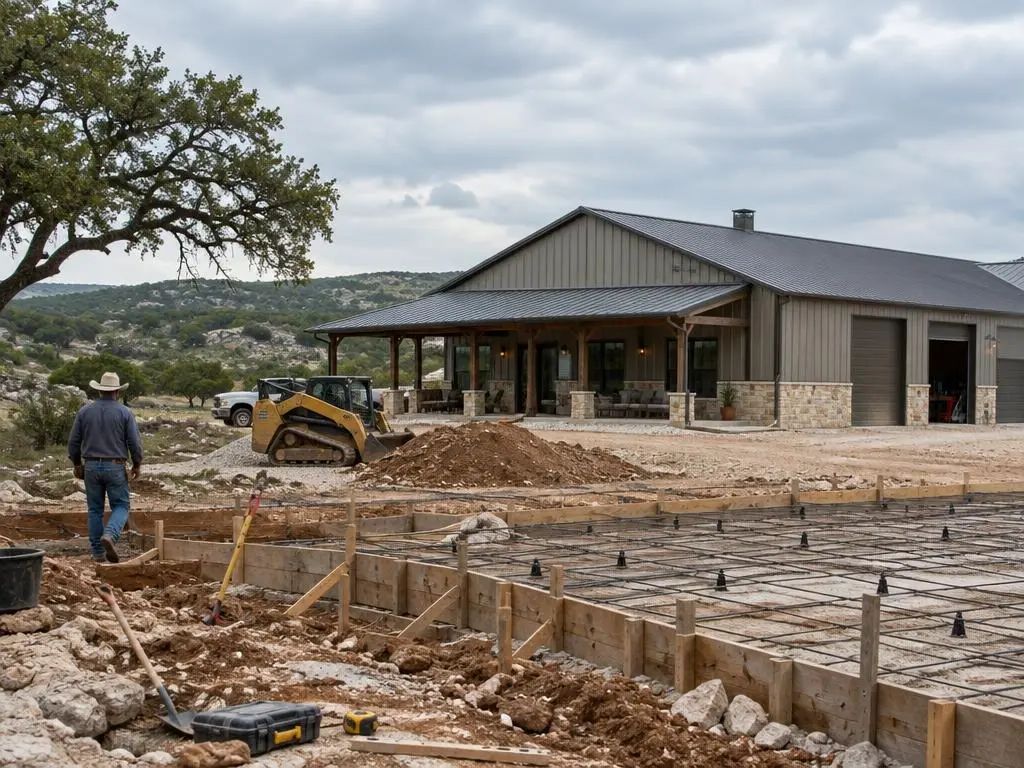
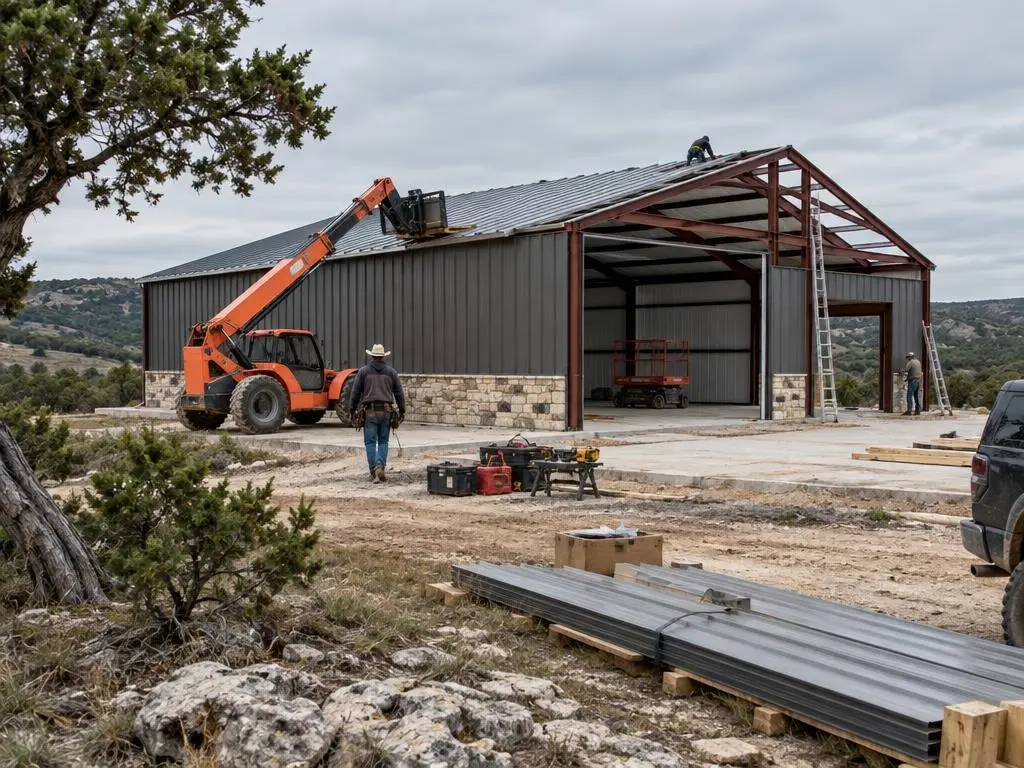
It depends on permits, septic approval, weather and finish level. The phases are site prep, slab and cure, shell erection, dry-in, rough-ins and inspections, insulation, and interior finish-out. We give you a phase schedule with the written estimate.
Steel frame or wood post-frame: which is better for Texas?
Both work. Red-iron steel frames allow wide clear spans for shops and large open rooms. Wood post-frame can be simpler to insulate and finish. Wind exposure, span, budget and what your lender and county expect all factor in; we walk through the trade-offs for your site.
Do metal barndominiums get condensation problems?
They can if the envelope is not planned. Humid air contacting cold steel condenses. Continuous insulation such as closed-cell spray foam, sealed openings and a properly sized HVAC system are how we control it.
Why Homeowners Call Barndominium Builders TX
We see the land before we price it
A walk of the building site, drive route, slope, trees and drainage comes before any number, because Texas sites swing from rock to clay to sand.
County and septic research is part of the job
We find out whether your county has adopted the unincorporated-area residential code, what the local septic program needs, and what the flood map shows.
Line-item written estimates
Site prep, slab, building package, erection, insulation, mechanicals and finish-out are priced separately, in a format a lender can read.
A condensation and comfort plan
Insulation, vapor control and HVAC sizing are chosen for the whole metal envelope before the building is ordered.
Barndominium Services
Six ways to get a barndominium on Texas land, from a bare kit erected on your slab to a finished, move-in-ready home with a shop.
Custom Barndominiums
A barndo designed around your acreage, views, shop and family, with a foundation built for your soil.
Learn more →Barndominium Kits
Steel or post-frame barndo kits erected on a properly built slab, with the site work the kit price leaves out.
Learn more →Barndominium Floor Plans
Barndo layouts from compact 30x40 homes to large plans with shops, adapted to your land, sun and wind.
Learn more →Metal Building Homes
Steel-framed homes with wide clear spans and a finished look, detailed for Texas heat, humidity, wind and hail.
Learn more →Shop Houses
A working shop and comfortable living quarters under one roof, with the doors, power and separation each needs.
Learn more →Turnkey Barndominiums
One builder from bare land to keys in hand: site prep, septic coordination, shell, mechanicals and finishes.
Learn more →Plan Your Texas Barndominium
Free land visits and written estimates across Texas outside Houston and DFW.