
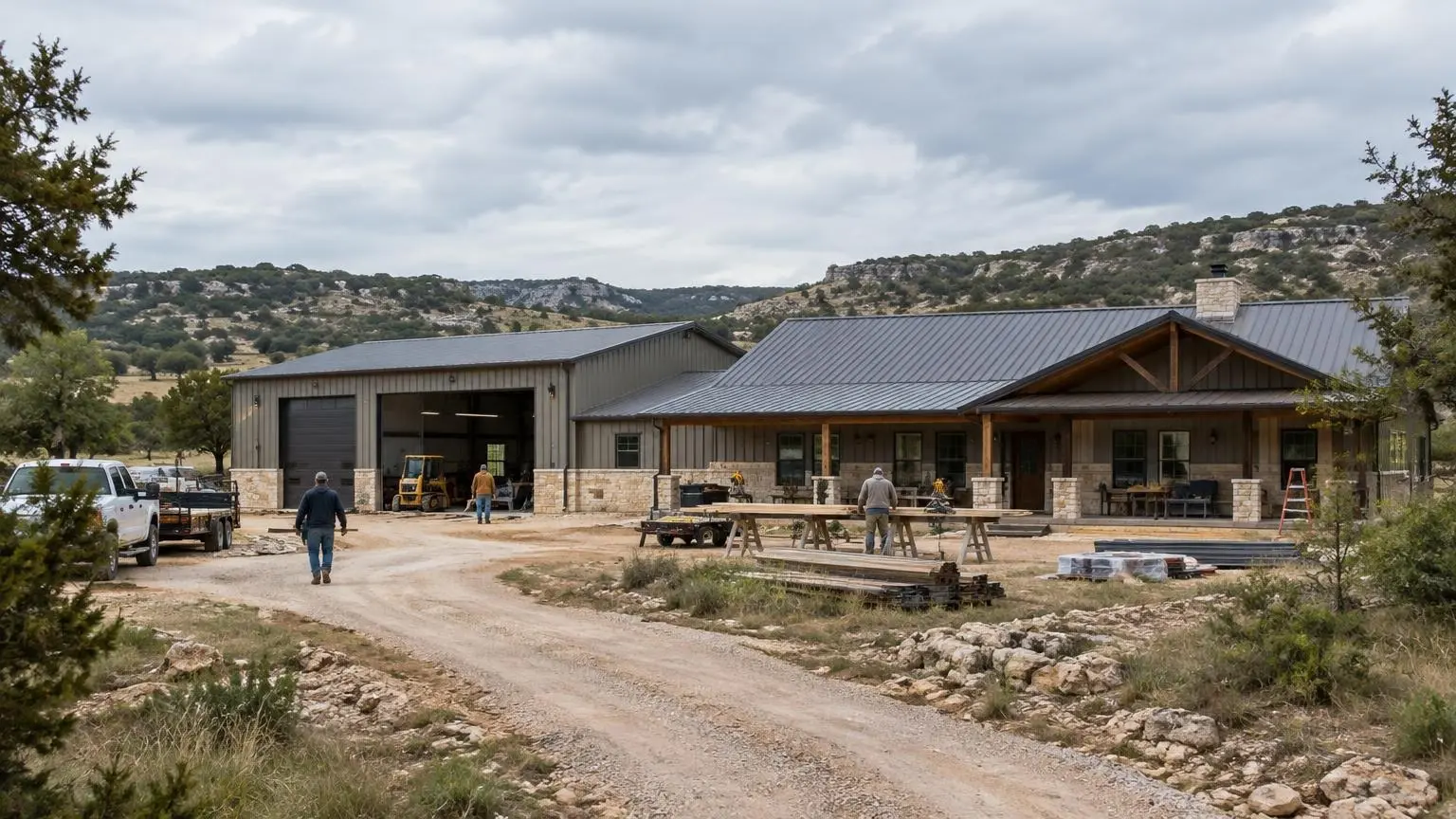
Travis County, both sides of the fault
Barndominium Builders in Austin, TX
Limestone hills west of town, black clay prairie east of it. The ground you buy decides how your barndo gets built.
- Free on-site land visits
- Written, line-item estimates
- County permit and septic research included
Building a Barndominium on Land Around Austin
Barndominium builders working around Austin have to deal with two different kinds of country. Austin is the county seat of Travis County and sits at the foot of the Balcones Escarpment on the Colorado River. The city straddles the Balcones Fault, so the eastern side is mostly flat with heavy clay and loam soils, while the western side rolls into the edge of the Texas Hill Country over limestone. A barndominium on a few acres near Manor and one on a cedar-covered lot past Lake Travis can need very different foundations, septic systems and site work.
Two counties in one
Travis County covers 1,023 square miles, 990 of them land. The western part is karst Hill Country, limestone with caverns and springs such as Barton Springs and Hamilton Pool. The eastern part is plains and old farmland that was planted in cotton for generations. Before we price a shell, we want to know which side of the fault your property is on.
East of I-35: Houston Black clay
The official USDA description for the Houston Black soil series lists its type location in Travis County, near Manor. It is a Blackland Prairie clay with high shrink-swell potential. In dry spells it cracks open, with cracks 0.5 to 4 inches wide that run 12 inches or deeper, and in most years those cracks stay open for 90 to 150 days in total. Permeability is very slow and runoff is high. For a steel or post-frame barndo, that means the slab design, the moisture control around the perimeter and the drainage around the building all matter more than the wall panels.
West of Austin: rock and runoff
On the Hill Country side the problem flips. Thin topsoil over limestone means excavation can turn into rock work, and the city's own history notes that this thin topsoil makes parts of the area prone to flash floods from thunderstorm runoff. Pad placement, driveway crossings and where water leaves your lot get worked out before the slab is formed.
Who issues the permits
Inside Austin city limits, the city's codes apply. In the city's extraterritorial jurisdiction, Texas law says the municipality's adopted building code controls. Out in unincorporated Travis County, the rules are set by Chapter 233, Subchapter F of the Texas Local Government Code for counties it covers. Section 233.153 requires new single-family homes and duplexes there to meet the International Residential Code as published May 1, 2008, or the version used in the county seat. It also says the subchapter does not require county approval before new residential construction begins and does not give the county zoning power. Deed restrictions and HOA covenants are a separate question, and we ask for them early because some subdivisions limit metal siding.
Septic on rural Travis County lots
Most acreage outside city utility lines needs an on-site sewage facility. The Texas Commission on Environmental Quality runs the statewide OSSF program and keeps a county map showing the authorized agent that handles septic permits for each county. A site and soil evaluation comes first; tight clay in the east and shallow rock in the west both narrow the choice of system.
Weather to build for
Austin's records run from 112 degrees, reached in September 2000 and August 2011, down to minus 2 in January 1949. The area sits on the far southern edge of Tornado Alley by most classifications. We size insulation, HVAC and roof design for long hot summers and the occasional hard freeze.
Room to grow
Travis County grew from 1,024,266 people in 2010 to 1,290,188 in 2020, a 26 percent jump.
Have land in Travis County or under contract? Call (254) 401-5175 or
and tell us where it is.Austin and Travis County Building Notes
- On the fault line. Austin straddles the Balcones Fault: flat heavy clay and loam to the east, limestone Hill Country to the west.
- Home of Houston Black clay. The USDA type location for the Houston Black series, a high shrink-swell Blackland Prairie clay, is in Travis County near Manor.
- County size. Travis County covers 1,023 square miles, 990 of them land, with the Colorado River forming Lake Travis, Lake Austin and Lady Bird Lake.
- Growth. Travis County went from 1,024,266 residents in 2010 to 1,290,188 in 2020, a 26.0 percent increase.
- Temperature range. Austin's recorded extremes are 112 F (2000 and 2011) and minus 2 F (January 31, 1949).
Austin Questions
Does it matter if my Travis County land is east or west of I-35?
Yes. East of the fault you are usually on expansive Blackland clay, which drives slab and drainage design. West of it you are often on shallow limestone, which drives excavation, septic choice and runoff control.
Do I need a county building permit for a barndominium in unincorporated Travis County?
Section 233.153 of the Texas Local Government Code sets IRC-based standards for new homes in unincorporated areas of covered counties and says it does not require county approval before construction starts. Septic, floodplain and driveway rules still apply, and a city's ETJ follows the city's code. We confirm the exact requirements for your address.
Who handles septic permits for my lot?
TCEQ's OSSF program lists an authorized agent for each county. A site and soil evaluation is the first step, and the system type depends on what that evaluation finds.
Can I build a barndo with a big shop on acreage near Austin?
Usually, as long as deed restrictions allow it. We plan shop bays, living space and the slab together so the clay or rock under the building is handled once.
Free Estimates in Austin, TX
Tell us where your Travis County land is and what you want to build.
Barndominium Builders Near Austin
- Barndominium Builders in San Antonio, TX
- Barndominium Builders in Waco, TX
- Barndominium Builders in Temple, TX
- Barndominium Builders in Killeen, TX
- Barndominium Builders in Georgetown, TX
- Barndominium Builders in New Braunfels, TX
- Barndominium Builders in San Marcos, TX
- Barndominium Builders in Seguin, TX
- Barndominium Builders in Boerne, TX
- Barndominium Builders in Fredericksburg, TX
- Barndominium Builders in Kerrville, TX
- Barndominium Builders in Dripping Springs, TX
- Barndominium Builders in Bastrop, TX
- Barndominium Builders in College Station, TX
- Barndominium Builders in Brenham, TX
- Barndominium Builders in Tyler, TX
- Barndominium Builders in Longview, TX
- Barndominium Builders in Lufkin, TX
- Barndominium Builders in Nacogdoches, TX
- Barndominium Builders in Beaumont, TX
- Barndominium Builders in Corpus Christi, TX
- Barndominium Builders in Victoria, TX
- Barndominium Builders in Lubbock, TX
- Barndominium Builders in Amarillo, TX
- Barndominium Builders in Abilene, TX
- Barndominium Builders in San Angelo, TX
- Barndominium Builders in Midland, TX
- Barndominium Builders in Wichita Falls, TX
- Barndominium Builders in Sherman, TX